



An Executive Briefing from capSpire
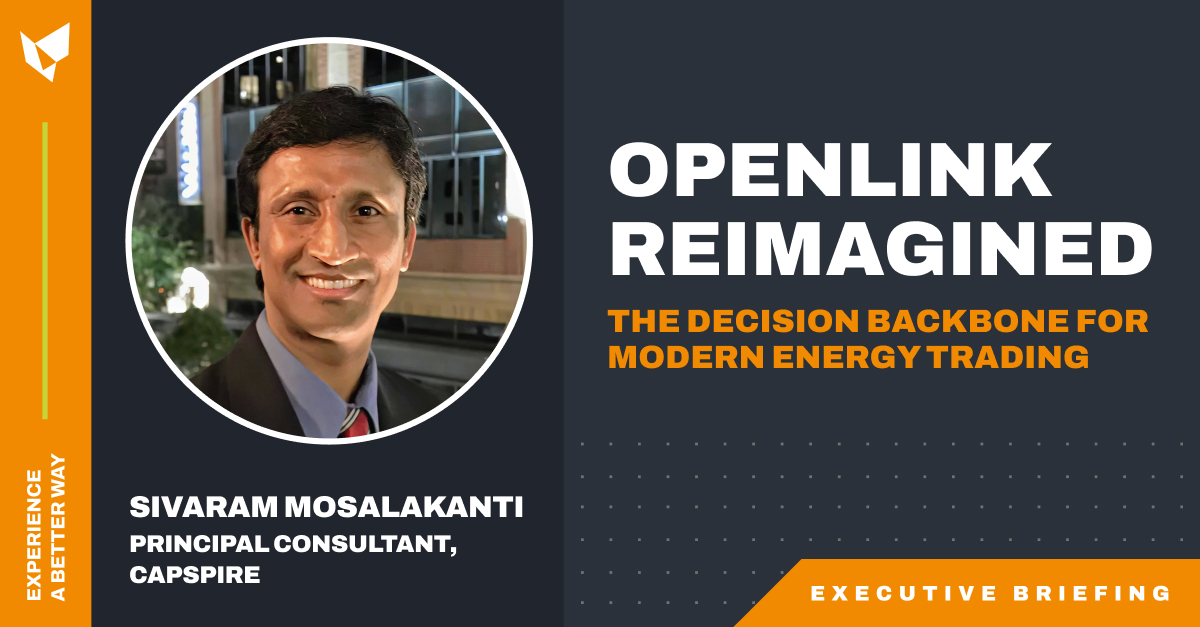
Author: SivaRam Mosalakanti, Principal Consultant, capSpire
For decades, ION Commodities’ Openlink has been a leading ETRM and CTRM platform. Organizations have relied on it to capture trades, manage risk, support logistics, and execute settlements across commodity markets.
Yet today’s energy landscape demands more than transaction processing. The energy transition, renewable generation growth, carbon markets, and increasing market volatility have fundamentally changed how commodity organizations operate. Success now depends on making faster, more informed decisions across interconnected markets, assets, and functions.
The opportunity is no longer just managing transactions. It is orchestrating decisions.
The Shift from Transactions to Decisions
Today, market participants need answers to more dynamic challenges. Where should we deploy capital next? How should exposure be adjusted as market conditions change? What are the implications of a regulatory or operational shift across the full portfolio?
Historically, Openlink has been used to answer operational questions: What positions do we hold? What is our current risk exposure? What is our financial outcome?
The foundation for answering these questions already exists within Openlink’s architecture. Trading, risk, logistics, scheduling, settlements, and finance data are all connected within a single platform. When fully leveraged, Openlink enables integrated physical and financial decision making, continuous optimization of commercial and operational positions, and faster responses to changing market conditions.
This is what it means to move Openlink from a reporting platform to a decision platform.
The Cross Domain Intelligence Built Into Openlink
One of Openlink’s most underused strengths is its ability to connect markets, assets, and business functions that often operate in separate systems.
A change in natural gas prices, for example, affects power generation economics, carbon exposure, dispatch decisions, hedging requirements, and portfolio profitability simultaneously. Openlink has the ability to connect those relationships within a single operational framework, allowing organizations to evaluate the full downstream effect of a market move rather than responding to each in isolation.
The same applies across physical assets and financial markets, front and back office functions, and supply, demand, and live market prices. The potential for cross domain intelligence is built into the platform. Realizing it requires deliberate design across data models, workflows, and the processes that connect teams.
For many organizations, the challenge is not technology capability. It is operationalizing that capability.
Why the Energy Transition Demands More From Your ETRM Platform
The energy transition is creating new commercial and operational requirements at pace. Organizations must increasingly manage:
- Diverse generation portfolios across wind, solar, natural gas, coal, and nuclear
- Carbon accounting obligations and emerging commodities such as hydrogen
- Renewable Power Purchase Agreements with complex contract and settlement structures
- Evolving ESG and regulatory reporting requirements at scale
Openlink is well positioned to serve as the transactional and analytical backbone for this evolution. However, realizing that value requires moving beyond implementations focused solely on trade capture and reporting. Organizations that implemented the platform years ago may find their current configuration no longer reflects the commercial reality they are operating in today.
Five Ways to Get More From ION Openlink
capSpire helps organizations get more from Openlink across five key areas:
- Designing decision architecture that aligns the platform with business strategy rather than just operational process
- Operationalizing cross domain intelligence by integrating front, middle, and back office processes into a unified view of portfolio risk and performance
- Building a connected data model that incorporates market, operational, asset, and weather data to support scenario analysis and forward looking decisions
- Accelerating energy transition use cases including new commodities, renewable PPAs, and evolving ESG and regulatory requirements
- Enabling AI driven decision support embedded directly into trading, risk, and operational workflows
capSpire brings a track record of delivering, optimizing, and supporting Openlink environments across some of the world’s most complex energy and commodity trading organizations, with a depth of platform expertise that is difficult to find elsewhere in the market.
From System of Record to Decision Platform
The organizations that get the most from Openlink have made a deliberate choice about how they intend to operate. They have aligned the platform with commercial strategy, connected data and processes across functional teams, and continuously adapted their configuration as markets and business models evolve.
The result is an organization that can evaluate risk and opportunity across the full value chain and act on it faster than its counterparts.
Openlink provides the foundation. capSpire activates its intelligence.
Learn more about capSpire’s Openlink Endur services.
Learn more about capSpire’s Openlink Findur services.
About the author
SivaRam Mosalakanti is a Principal Consultant at capSpire with a reputation built over years of deep client delivery across the ION Openlink ecosystem. His expertise spans Endur and Findur across cloud infrastructure on AWS and Azure, database performance tuning, module configuration, and system administration – making him one of the most experienced Openlink specialists working in the industry today.

SivaRam Mosalakanti, Principal Consultant