



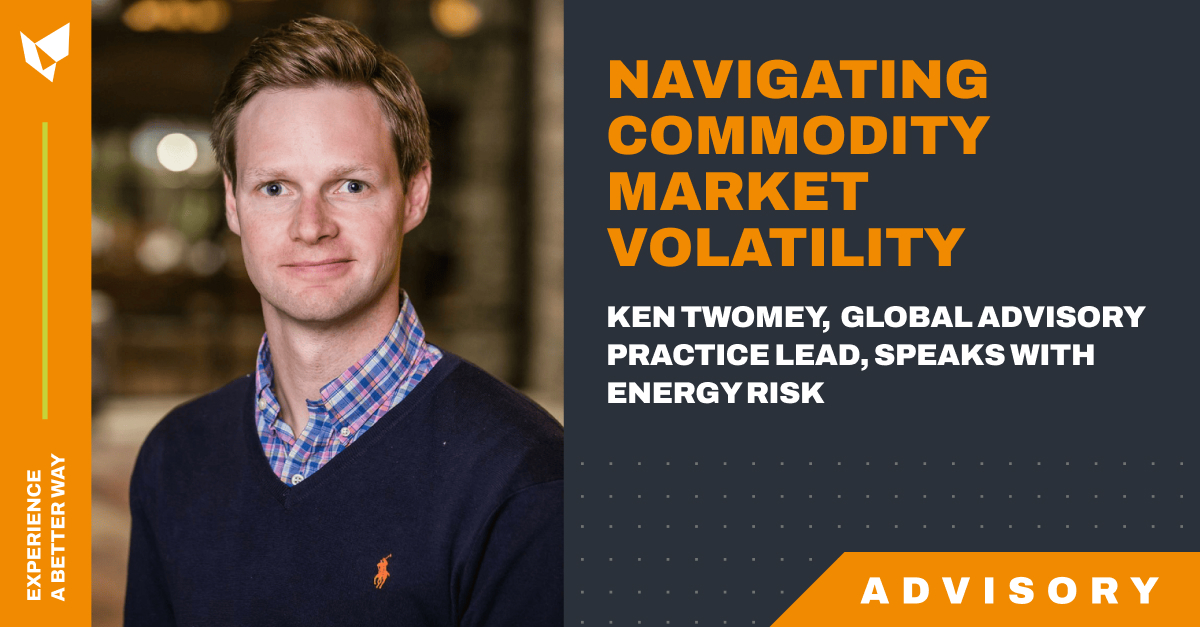
In this Energy Risk interview, capSpire’s Global Advisory Practice Lead Ken Twomey joins Stella Farrington, Head of Content at Energy Risk, to discuss what today’s commodity market volatility means for trading firms worldwide.
They examine why repeated market shocks may no longer qualify as traditional “tail risks,” why firms need faster visibility into exposures and margin requirements, and how volatility is exposing gaps across risk, finance, systems, and processes.
Ken also addresses the second-order impacts of volatility, including widening spreads, proxy hedging challenges, timing differences in physical commodity markets, and embedded optionality in contracts.
Watch the full interview below
17-minute interview · Filmed for Energy Risk
Video duration: Approximately 17 minutes 55 seconds
In this interview, Ken Twomey discusses:
- 00:00 – Why commodity market volatility has become a global business issue
- 02:30 – The intraday visibility gap for CROs and CFOs
- 05:15 – Why price is only the first risk in volatile markets
- 08:00 – Second-order impacts on spreads, hedging, timing, and contracts
- 11:30 – Connecting market, commercial, financial, and operational risk
- 14:45 – Building fit-for-purpose risk management capabilities
FAQs
Are today’s commodity market shocks still considered tail risks?
Today’s commodity market shocks may no longer qualify as tail risks. Repeated energy crises, geopolitical disruption, tariffs, and sharp market moves mean volatility is becoming a persistent business challenge rather than a rare exception, as Ken Twomey discusses in the interview.
Why do commodity trading firms need intraday risk visibility?
In fast-moving commodity markets, waiting until the next morning may be too late. CROs need earlier visibility into exposures, and CFOs need timely insight into margin requirements, liquidity, and business impact. Intraday visibility is becoming a baseline requirement rather than a competitive advantage.
Why is price only part of the risk in volatile commodity markets?
Price moves are only the first risk. Second-order impacts can be just as material and include widening spreads, proxy hedging gaps, physical timing differences, and embedded optionality in contracts. These risks often sit quietly in stable markets and become business-critical in volatile ones.
What are second-order risks in commodity trading?
Second-order risks are indirect effects that emerge when markets move sharply. Examples include spread movements across regions or products, hedging breakdowns, physical timing gaps, margin pressure, and contractual clauses being triggered. They are typically harder to model than directional price risk.
What are the four dimensions of commodity risk discussed in the interview?
Ken Twomey outlines four dimensions of commodity risk: market risk, commercial risk, financial risk, and operational risk. These dimensions often sit across different teams, systems, data sources, and reporting cadences, which is why fragmented visibility becomes the business problem when volatility hits.
Why is physical commodity risk difficult to manage?
Physical commodity risk is difficult to manage because contracts are complex, operationally specific, and often include optionality. Data can be manual or delayed, which prevents the risk view from reflecting reality. Bringing physical, financial, and operational data into one coherent view is a persistent challenge for global commodity firms.
What does false confidence in risk management mean?
False confidence in risk management occurs when a risk framework works under normal conditions but has not been tested against real volatility. Market stress can expose weaknesses in controls, metrics, hedging, margining, and risk visibility that were not apparent during stable periods.
What do firms that manage volatility well have in common?
Firms that manage volatility well share three habits: they trust their numbers intraday, they align risk, trading, and finance around the same data, and they actively review their risk frameworks and policies rather than treating them as static documents.
How should commodity firms stress test their risk frameworks?
Effective stress testing goes beyond price shocks. Firms should consider market correlations, physical supply disruption, second-order impacts, margin requirements, and whether decision-makers can access risk numbers in time to act on them. Stress tests are most useful when they reflect real operating conditions, not theoretical
ones.
What is a fit-for-purpose risk management framework?
A fit-for-purpose risk management framework is one that matches the way a business actually operates – not over-engineered, not one-size-fits-all. It addresses the firm’s specific products, markets, contract types, and operational reality, and it evolves as the business and market environment change.
How is commodity risk management changing in 2026?
Commodity risk management in 2026 is being reshaped by persistent volatility, faster margin cycles, and the need for connected visibility across market, commercial, financial, and operational risk. Firms are moving away from end-of-day-only reporting and toward intraday risk frameworks that span systems, teams, and data sources.
How does capSpire help commodity trading firms improve risk management?
capSpire helps commodity trading firms assess risk management maturity, identify gaps in systems, data, processes, and controls, then design a pragmatic, maturity-led roadmap to close them. The approach is fit-for-purpose: not over-engineered, not one-size-fits-all, and aligned to how the business actually operates.